
Table of Contents
Request a free quote
Introduction
The OWASP Top 10 2025 is here marking the 8th official installment of the industry’s most influential web application security standard. This update reflects the evolving landscape of modern software development, from cloud-native systems to supply chain complexity and AI driven applications.
For cybersecurity professionals, developers, and AppSec consultants, this release provides not only a refreshed prioritization of risks but also a sharper focus on secure by design practices, software integrity, and proactive monitoring.
At Secure Wave Advisors, we believe understanding and implementing the OWASP Top 10 2025 is essential for building resilient and trustworthy digital systems.
The Official OWASP Top 10 2025
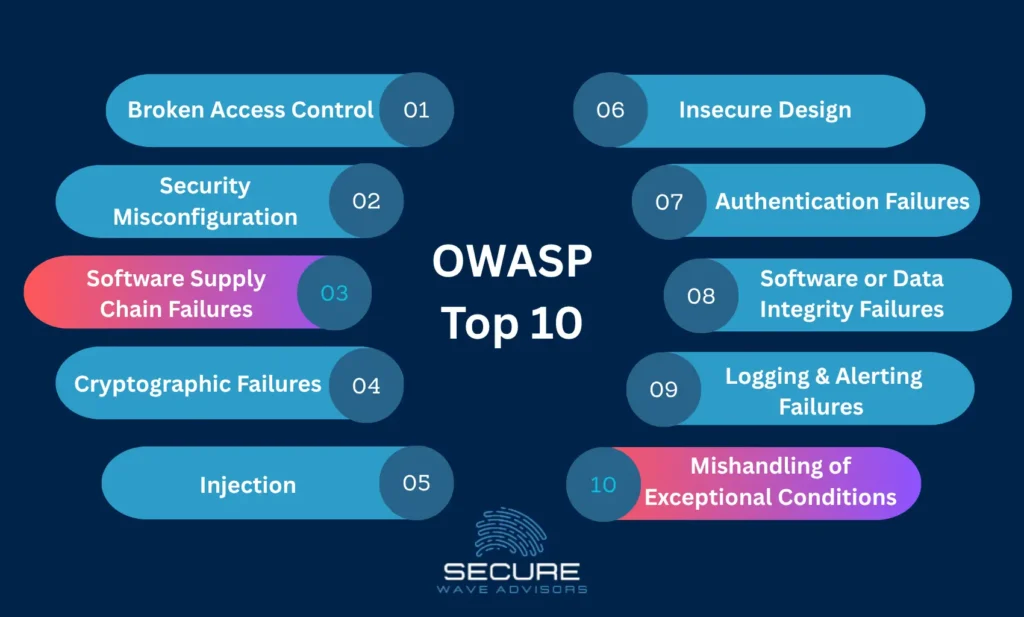
The OWASP Foundation has officially introduced the following categories for 2025:
- 1. A01:2025 Broken Access Control
- 2. A02:2025 Security Misconfiguration
- 3. A03:2025 Software Supply Chain Failures
- 4. A04:2025 Cryptographic Failures
- 5. A05:2025 Injection
- 6. A06:2025 Insecure Design
- 7. A07:2025 Authentication Failures
- 8. A08:2025 Software or Data Integrity Failures
- 9. A09:2025 Logging & Alerting Failures
- 10. A10:2025 Mishandling of Exceptional Conditions`
Each category highlights the most pressing threats based on industry data, security research, and vulnerability analysis across thousands of organizations worldwide.
1. A01: Broken Access Control
Broken access control remains the top risk in 2025, emphasizing the importance of proper authorization enforcement.
Common scenarios include:
- Unrestricted API endpoints
- Vertical or horizontal privilege escalation
- Insecure direct object references (IDOR)
Mitigation:
Implement least privilege principles, enforce server-side authorization checks, and use continuous testing to identify broken access controls.
2. A02: Security Misconfiguration
Misconfigurations continue to plague modern applications. From default credentials to unsecured cloud storage buckets, configuration drift often leads to compromise.
Example: Exposed admin interfaces or verbose error messages.
Mitigation:
Automate configuration management using IaC scanning, enforce secure defaults, and regularly audit your environment against security baselines.
3. A03: Software Supply Chain Failures
A major new entry in 2025, this category reflects one of the most significant risks today: dependency and package compromise.
Example: Malicious updates in npm, PyPI, or container registries.
Mitigation:
Adopt SBOM (Software Bill of Materials) practices, validate third-party dependencies, and use signed and verified libraries only.
4. A04: Cryptographic Failures
Poor encryption practices continue to expose sensitive data. Insecure algorithms, mismanaged keys, or lack of encryption in transit are major culprits.
Mitigation:
Use strong, modern algorithms (AES-256, RSA-2048+), enforce TLS 1.3, and adopt centralized key management.
5. A05: Injection
Injection flaws including SQL, NoSQL, and OS command injection remain a persistent threat due to poor input validation and unsafe API calls.
Mitigation:
Use parameterized queries, input sanitization, and context aware encoding. Adopt ORM frameworks and avoid dynamic query construction.
6. A06: Insecure Design
Introduced in 2021 and still highly relevant in 2025, insecure design underscores architecture level weaknesses that can’t be patched later.
Mitigation:
Perform threat modeling early in the SDLC, adopt security design patterns, and build “secure by design” principles into your development process.
7. A07: Authentication Failures
Authentication issues from weak password policies to misconfigured identity tokens continue to cause breaches.
Mitigation:
Implement MFA, enforce modern passwordless authentication (FIDO2, WebAuthn), and protect session tokens from replay or fixation attacks.
8. A08: Software or Data Integrity Failures
Integrity failures involve unauthorized data manipulation or tampered software artifacts.
Example: Unsigned application updates or modified configuration files.
Mitigation:
Digitally sign builds, enforce code integrity verification, and validate checksums for downloaded dependencies.
9. A09: Logging & Alerting Failures
Security events that go undetected can turn minor incidents into full-blown breaches.
Mitigation:
Centralize logs, integrate SIEM/SOAR solutions, and establish automated alerts for anomalous behaviors.
10. A10: Mishandling of Exceptional Conditions
A new and noteworthy entry, this category covers inadequate handling of unexpected inputs, states, or failures.
Example: Uncaught exceptions that reveal stack traces or crash applications.
Mitigation:
Implement robust error handling, use input validation libraries, and avoid exposing internal system details in error messages.
How OWASP Top 10 2025 Reflects the Future of AppSec
The 2025 update showcases a clear trend:
- From reactive patching to proactive design
- From isolated testing to supply chain visibility
- From human only threats to automation driven risk
These changes align with modern practices such as DevSecOps, threat modeling, and continuous compliance ensuring security is embedded across every phase of development.
How Secure Wave Advisors Helps You Stay Ahead
At Secure Wave Advisors, we integrate OWASP Top 10 2025 principles into every aspect of our consulting and advisory services:
- OWASP Top 10 2025 readiness assessments
- Secure design and architecture workshops
- Supply chain risk and SBOM audits
- CI/CD pipeline security automation
- Incident detection and alerting optimization
Our goal is to ensure your applications are not only compliant but resilient against evolving threat vectors.
FAQs
It reflects the surge in third party dependency attacks, which have become a primary threat vector in cloud native environments.
“Software Supply Chain Failures” and “Mishandling of Exceptional Conditions” are new entries, while others have been renamed or restructured.
No it applies equally to APIs, mobile, and distributed systems.
Map existing controls to OWASP 2025 categories, prioritize risks, and align your SDLC with secure design practices.
It’s a foundation, not a full security program. Use it alongside NIST, ISO 27034, and CIS frameworks.
We provide end to end AppSec consulting from architecture reviews to DevSecOps implementation aligned with OWASP 2025.
Conclusion
The OWASP Top 10 2025 underscores a transformative shift in application security from reactive defense to proactive resilience. With supply chain visibility, secure design, and authentication integrity now central, organizations must evolve beyond surface level scanning.
At Secure Wave Advisors, we help clients implement OWASP 2025 principles to build security into every line of code and every architectural decision ensuring your software is not only functional but fundamentally secure.
Stay secure. Stay compliant. Stay ahead.
Reference: